Friday, December 2, 2011

Rome: Day 4 Nov. 23


Our tour guide was able to get tickets for us to attend the papal audience so Tom and I decided to go and then catch up with our group at lunch.  We knew the way using the Metro and figured we couldn’t get lost.  The audience was scheduled for 10:30 and we arrived about 9:45 but not before many others were already seated.  The audience was held in a giant auditorium (8000-10,000 seating capacity) complete with jumbo screen (but no advertisements).  Groups of pilgrims had come from all over the world and had brought their music with them.  A group from Brazil enthusiastically waved their flag and sang their national anthem to an accompanying band.  An Italian group sang “O Solo Mio.” Others chanted and cheered.  We ended up sitting in front of a young couple from West Virginia who worked at Nazareth Farm.  At least we could understand each other.  Pope Benedict XVI walked in around 10:40 with his Swiss Guards in their colorful uniforms and others in plain clothes.  After a short greeting (in Latin), about seven different priests who were sitting on the stage read the same short passage from the Gospel of Matthew in their native tongue.  Then, from his chair, the pope gave a talk about his trip to Africa.  At least that is what we thought it was about since it was in Italian but we could recognize the word “Africa.”  After that, each of the original priests introduced groups of pilgrims who spoke his language and, as the saying goes, the crowd went wild.  Each named group stood and cheered or sang.  It definitely had the feeling of a rock concert.  After each country’s groups were introduced, the pope greeted them in their native tongue.  The audience ended a bit more than an hour after it had started with the entire group reciting the Our Father (in Latin). 

Papal Auditorium


We left the auditorium and headed to a Sicilian restaurant where our group was meeting for lunch.  This was my favorite meal of all.  We were in a beautiful restaurant, the food was delicious, and the every time a wine bottle was emptied, another appeared in its place.  The owner gave us a short cooking demonstration so we were able to see how our food was going to be prepared.  The menu consisted of salad with prosciutto and parmigiano; two simple pastas-one with a tomato, olive and basil sauce and the other with a pistachio and cream sauce; pork with a bread stuffing, and cannelloni and coffee for dessert.  Good thing we went walking afterwards because it was a bountiful meal.


While we waited for our tour group to arrive, a family from Columbus OH came into the restaurant.


In the kitchen with the chef


Delizioso!


Our walk from the west side of the Tiber to the east took us past a rebuilt aqueduct, the Spanish Embassy, a very small church, and finally a neighborhood called Trastevere.


The aqueduct Fonte Acqua Paola was rebuilt by Pope Paul V, a member of the Borghese family.  The aqueduct provided water for the west side of the Tiber where the Vatican is located.


The coat of arms of the Borghese family--the dragon and the eagle--are included in the papal symbol.


The Spanish Embassy with views over the city


The church San Pietro in Montorio includes this tiny temple, or Tempietto, that commemorates the spot of St. Peter's martyrdom.  Its design influenced many other churches-- St. Peter's, for example.


The interior of the Tempietto

Our walk led us downhill to the area called Trastevere, an authentic neighborhood of Rome.  A common sight is laundry hanging on lines strung across the street and that was our experience as well even though by this time there was a light rain.


The center of the neighborhood is the Piazza Santa Maria in Trastevere with its accompanying church.


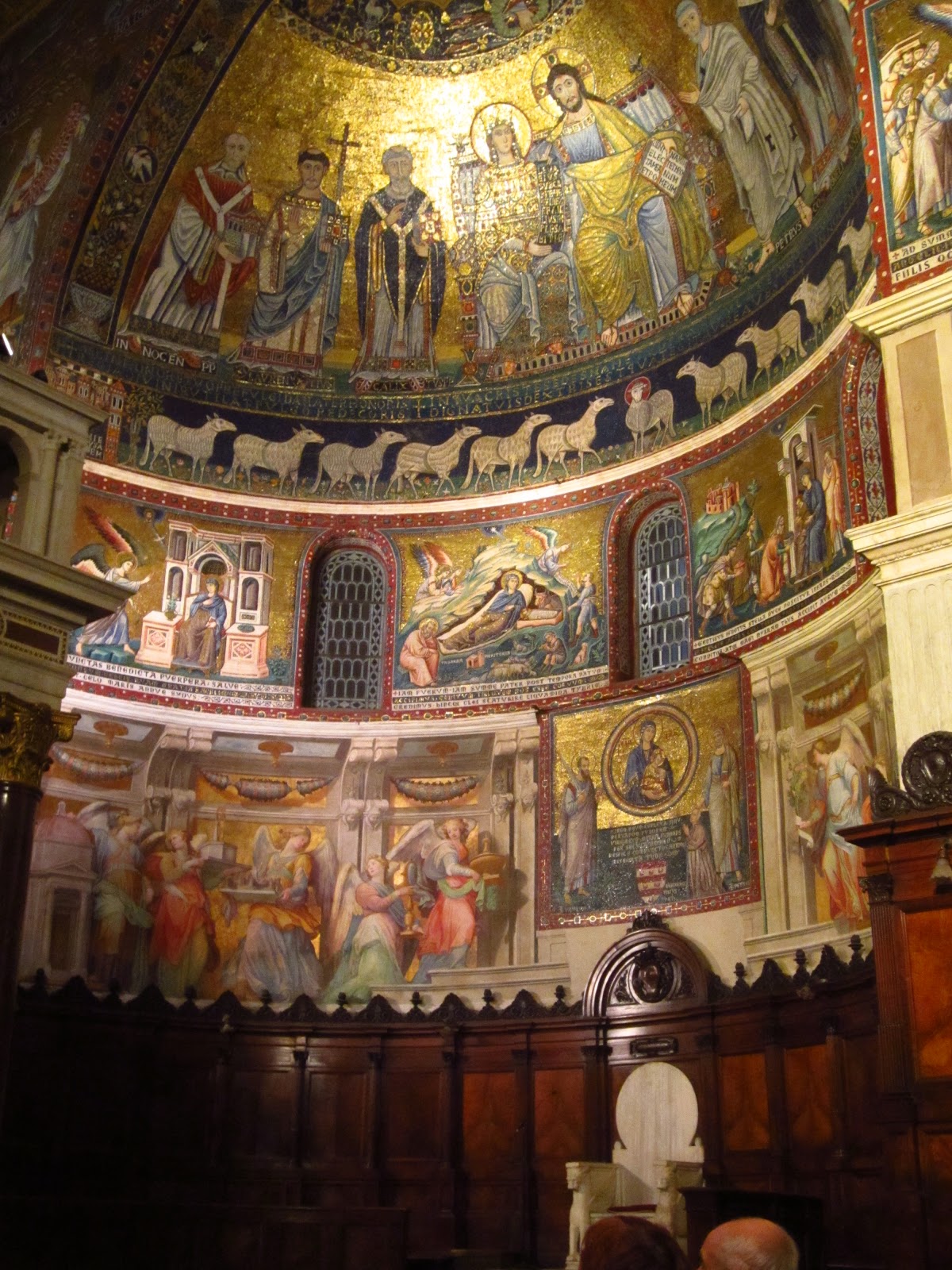
Santa Maria is one of the oldest churches in Rome and the first dedicated to the Virgin Mary.  It was my favorite church of all that we saw.  Its mosaics made the whole interior glitter.


The flock of sheep represents Christ and the 12 Apostles

Above the image of the lambs is a medieval mosaic of Christ and his mother dating from the 8th to 10 centuries.  This is the first time Mary has been portrayed this way.  Early popes surround the two figures.


Thursday, December 1, 2011

Rome Day 3: Nov.22


Our focus moved forward to the Renaissance era and it was another full day of marveling at collections of riches: marble statues, mosaic floors, golden ceilings, tapestries, frescoes, and gigantic buildings.  The main players for today were Michelangelo, Raphael, Bernini and the popes who hired them.  The all day rain didn’t affect our sight seeing much since we were inside the Vatican.  Again, we felt very fortunate to be part of a tour that could go right into the museum instead of waiting outside to buy tickets. 


A rainy day at the Vatican

Before we toured the Vatican Museum, we went to the Belvedere Courtyard where charts explained the Sistine Chapel frescoes.  We were not able to take photos inside the Sistine Chapel so some prior hints about what we would see were helpful.  There were other sculptures of interest as well.

Pine Cone--symbol  of Eternal Life
Sistine Chapel Guide


Sphere Within a Sphere, symbolizes the harsh difficulties of the modern world

Once inside the Vatican Museum, we concentrated on the highlights of the collection—even then the amount of information was overwhelming. 

Of all the small Roman statues, I found this set most charming.  I thought it could be used as an advertisement for a Roman beauty salon.


Four statues stood out among many for either their past significance or influence on Renaissance (Michelangelo) sculptors.


The Apollo Belvedere, a copy of a Greek statue, was once thought to be the most perfect work of art. He’s beautiful as both an athlete and a thinker; he shows movement but he’s not out of control, and he’s realistic but with godlike features.  Everything is in perfect balance.  However, today, he looks unemotional.


The pose of this statue of a Roman river god served as a model fro Michelangelo’s Adam in the Sistine Chapel.


Unlike the Apollo statue, this one of Laocoon and his sons being crushed by snakes is full of emotion and movement.  Laocoon has just warned the Trojans to “beware of Greeks bearing gifts” (the Trojan horse) but the Trojans think he is being punished by the gods and ignore him.


 The muscular Belvedere Torso is all that is left of a statue of Hercules but to Michelangelo it is the most important statue in the collection.  It served as his inspiration for figures in the Sistine Chapel.


The Museum’s collection continued with dazzling ceilings, purple marble from Egypt, a bronze statue, and tapestries.


Porphyry marble from Egypt.  It is rare but there seemed to be quite a bit of it in the Vatican Museum.


                                        The only bronze statue in the museum


Tapestry, made in Brussels from drawings by
Raphael


The last part of the Museum that we studied was the Raphael Rooms and in particular, his frescoes of “The Dispute” and “The School of Athens.”  A favorite of Pope Julius II like his contemporary Michelangelo, Raphael possessed a much different temperament—sophisticated, handsome, more easy going and perhaps more generous.  After seeing Michelangelo’s work in the Sistine Chapel, Raphael paid homage to him by adding the brooding figure of Michelangelo resting on the block of marble in the “School of Athens” fresco.


"The Dispute" Christ and the saints oversee a discussion of the Eucharist by mortals


"School of Athens" Raphael pays homage to the great thinkers of ancient Greece and the Renaissance. 


Finally, the Sistine Chapel. Michelangelo created the nine panels on the ceiling in the Sistine Chapel along with “The Last Judgment,” the painting on the altar wall.  The panels are scenes from Genesis with the fourth one being the creation of Adam.  It is a true Renaissance perspective since God and Adam are on the same plane.  By the time Michelangelo painted the altar wall 23 years later, the spirit of the Renaissance had dissolved into a more somber mood.  The Protestant Reformation and the Catholic response turned the figure of Christ in “The Last Judgment” into a terrifying figure condemning the unjust to a life of torture while raising up the just.

We were told that there were far fewer visitors than normal to the Sistine Chapel but it still felt like a huge throng.  The guards’ modest attempts to keep the crowd silent were futile. 

The Basilica was the last part of our Vatican visit on Tuesday.  Due to chairs set up in the Basilica, we were unable to get close to some statues like the one of St. Peter.   We saw the tombs of Popes John XXIII and John Paul II; I’m hoping it was a mask I saw of John XXIII but his face (large nose) was easily recognizable.

Front of St. Peter's Basilica. The balcony is where the new pope is introduced.


        Cross topped obelisk in St. Peter's Square.


Statue of St. Peter--perhaps once the statue of a Roman senator with a different head

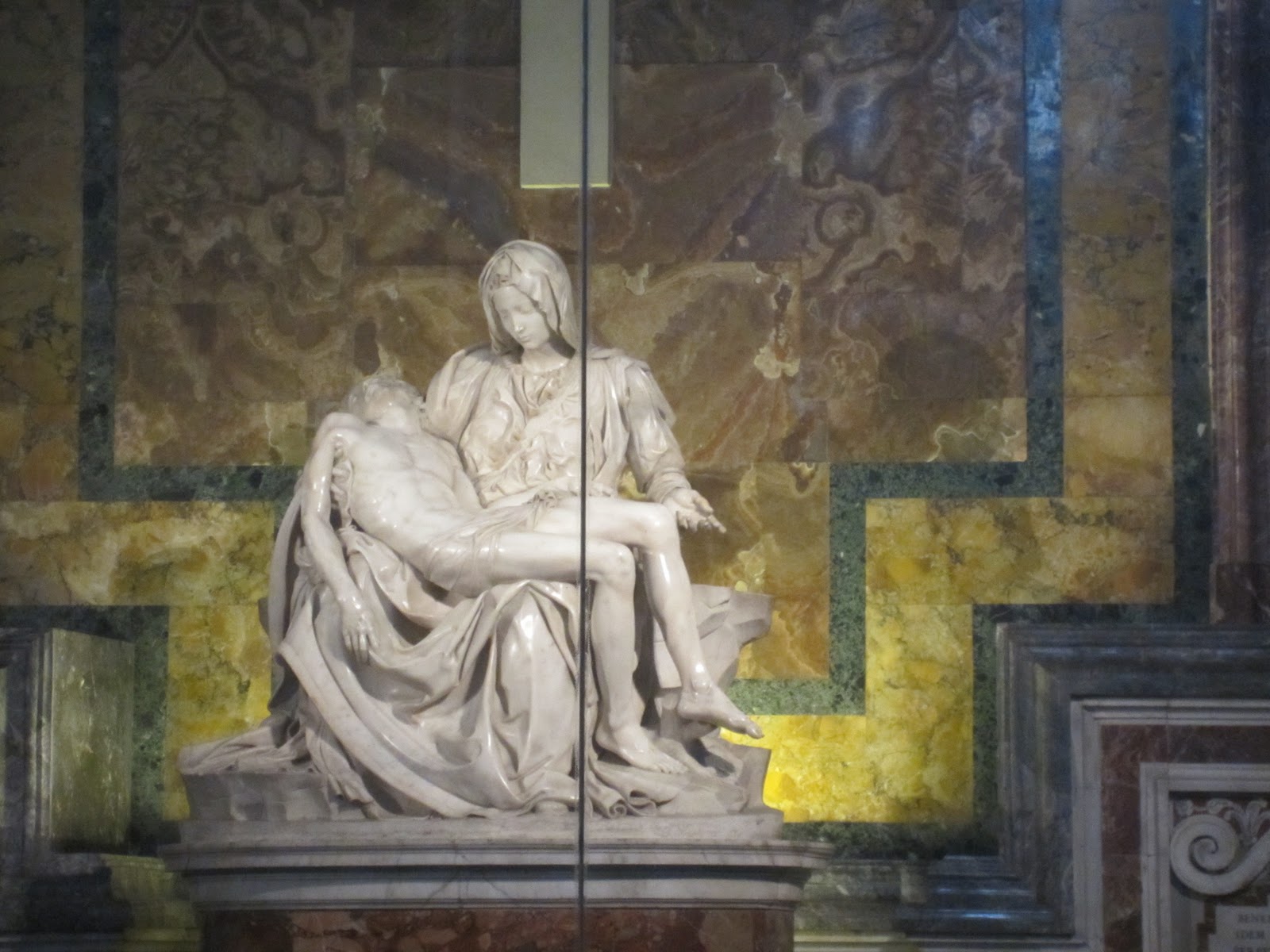
The Pieta now behind bullet proof glass
Bernini's Canopy over the Altar


Once we left the Vatican, we walked towards Castel Sant’Angelo, tomb of several emperors including Hadrian and home to popes under siege.  The bridge spanning the Tiber, Ponte Sant’Angelo, has sculptures of angels each bearing a symbol of Christ’s passion.


Rome is more than ruins, marble, and monuments.  It is also music and we were able to attend a concert of opera arias in a nearby church.  The evening was a delight and now on my bucket list is a desire to see an opera performed in a beautiful outdoor (preferably ancient) setting (the Cincinnati zoo does not qualify).


St. Paul's Anglican Church, site of a lovely concert


Rome: Day 2, Nov. 21


Our second day of touring dawned bright and chilly.  The goal was to see ancient Rome in a variety of locations.  Despite the fact that ruins seem to be present at every turn in the road, it is estimated that 80% are still undiscovered.  We boarded the Metro and headed towards the Colosseum  (Rome has only two Metro lines although a third one is being built.  So many ruins exist underground that excavation is very deep and extremely time consuming).

Our first stop was the multi-layered church of San Clemente (no pictures allowed inside).


St. Clements, exterior


Courtyard, St. Clements

The current ground level church is dedicated to St. Clement, an early pope who was put to death by drowning.  His symbol is the anchor which was a veiled symbol for Christianity before the cross was used openly.  Underneath this church is another earlier church where it is presumed St. Cyril is buried and which, in turn, was built upon a pagan temple.  It’s even possible to see part of a Roman road—all of three feet wide.  Walking there had to have been a noisy, bumpy experience.

A short walk away from St. Clements’ church was the Colosseum, or Flavian Amphitheater, its real name.  It was built in 80 A.D. when Rome was at its peak and the emperor, wishing to ingratiate himself with the impoverished masses, staged games of animal and human combat (Christians were probably NOT martyred here).  Less gory is the fact that the Colosseum is an impressive display of Roman engineers’ use of concrete and the rounded arch enabling its tremendous size.  The stadium held 50,000  people who could vacate the building in about 15 minutes. Only a third of the original structure exists today; natural erosion, earthquakes and salvaging for other building projects have taken their toll.  Today the Colosseum is the venue for dramatic musical productions, political demonstrations, religious services, and many, many tourist visits.


THe "romantic" view of the Colosseum. The tumbling bricks on the upper left (restored) are supposed to give a sense of the Colosseum crumbling during an earthquake.


Gladiator Training Quarters


Mosaic showing exotic animals whose ferocity thrilled the audience


Underground passageways and wooden playing surface covered with sand (arena) to soak up the blood


Several curious tourists


Long axis view of the oval shaped Colosseum.  It measures 280 feet  long by 165 feet wide hence the ratio of 5:3, the golden ratio so often found in nature.

The Arch of Constantine as seen from the Colosseum. The arch celebrates Constantine's victory over Maxentius in 312 A.D. thereby establishing Christianity as the state religion.

                         ~~~~~~~~~~~~~~~~~~~~~~~~~~~~~~~~~~~~~~~~~~~~~~~~~~~~

The next stop was the Roman Forum, the political, religious, and commercial center of the city.  At first glance it looked like a jumble of broken columns, arches, walls, and other pieces of marble.  Gradually individual structures became discernable.


The garden of the Vestal Virgins 

Vestal Virgins were responsible for maintaining the Temple of Vesta’s sacred flame, symbol of Rome’s endurance.  Vestal virgins served a term of 30 years; if they violated their vow of chastity, they were buried alive.


Basilica of Maxentius and Constantine (part of which can be seen in the second Vestal Virgins picture)

 In Roman times, a basilica was a combination courthouse, council chamber, and meeting hall. (Christians appropriated this structure for their use but changed the entrance to what we know today so that the building seems to be divided into three long rectangular areas).  The building that remains today is only a third of its original size; the roof would have been about 55 feet higher and the interior would have been furnished with colorful marble, a bronze ceiling, and statues of gods.


Detail, including menorah, of inside of arch

Arch of Titus

The Arch of Titus commemorates the victory of Rome over the Israelites of Judea who refused to honor the Roman gods including the emperor.  The temple in Jerusalem was destroyed (except for today’s “Wailing Wall”) and Jewish slaves were brought back to Rome to construct this arch.


Arch of  Emperor Septimius Severus

Another triumphal arch, built in 203 A.D.  This one commemorates the battles fought in Mesopotamia.  The Senate House or Curia, built in 283 A.D. is the yellowish colored building on the left.  This official center of government is where senators met to debate and create laws.

                   ~~~~~~~~~~~~~~~~~~~~~~~~~~~~~~~~~~~~~~~~~~~~~~~~~~~~~~~~~~

Leaving behind the Forum and its main street, the Sacra Via, we ambled up the Palatine Hill for a look at more ruins.The dominant feature on the Palatine Hill is the massive structure of the Imperial Palace, residence of emperors for three centuries beginning with the Emperor Domitian in 81 A.D. 


A look back as we walked up the Palatine Hill. The bell tower belongs to the Church of St. Maria in Cosmedin.


Views form the top of the Palatine Hill.  The white monument with two black horses in the first picture is the Victor Emmanuel Monument and can be see from all over the city.  It is NOT a favorite of the locals.


Ruins of the Imperial Palace


The Stadium, a garden with strolling paths beside the palace.  


Unlike his successors, Emperor Augustus lived in a modest dwelling of four rooms with little lavish marble and only painted arches and windows (but what colors!).  His sense of simplicity, however, did not survive.


Casa Augustus

              ~~~~~~~~~~~~~~~~~~~~~~~~~~~~~~~~~~~~~~~~~~~~~~~~~~~~~~~~~~~~~~

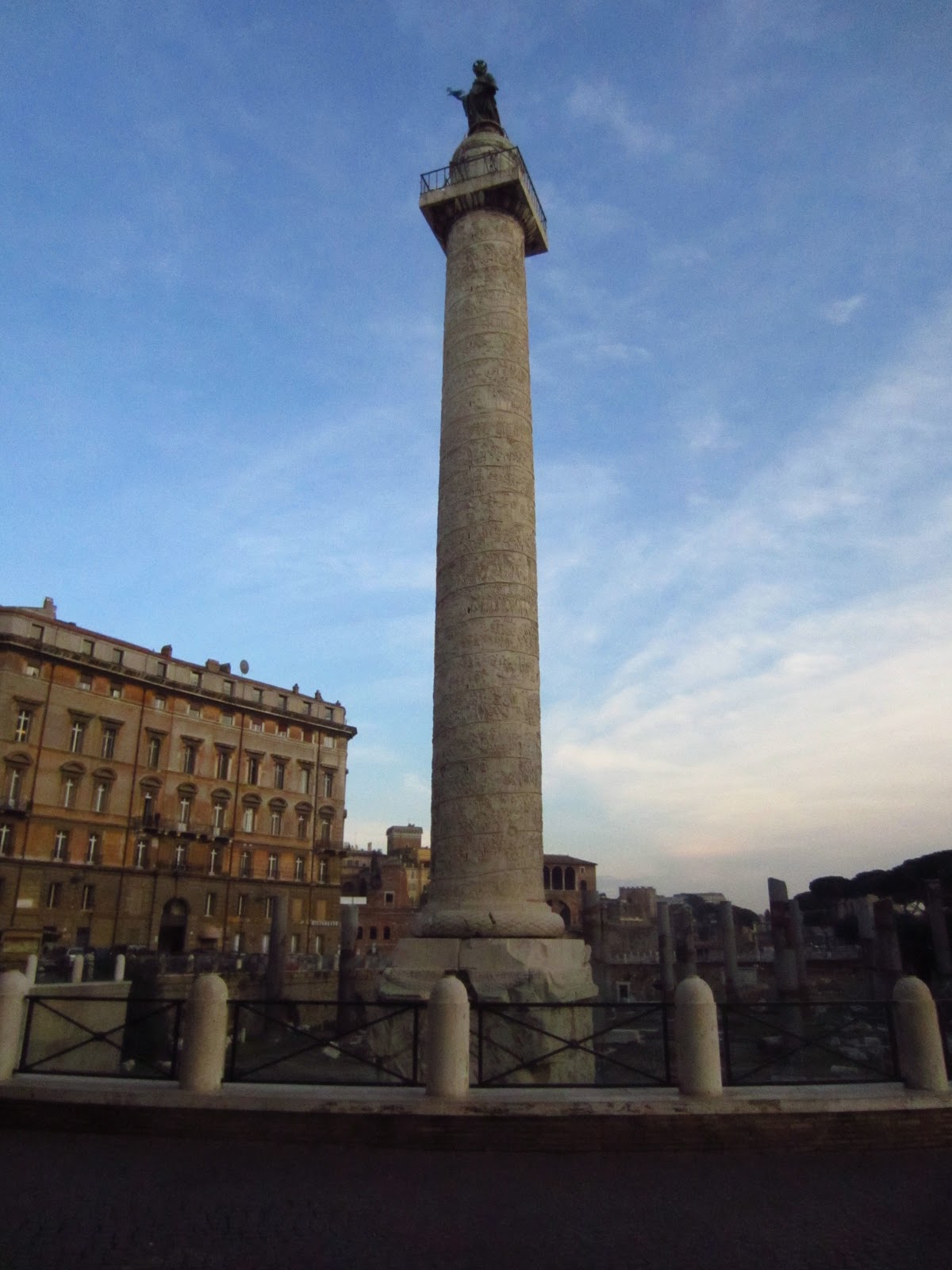
Our return walk to our hotel took us past emperor Trajan’s Column.  This column celebrates Trajan’s victories in Dacia, modern day Romania.  Once a statue of Trajan graced the top of the column; but now St. Peter reigns.  I had seen the plaster cast of this column, albeit in two sections, at the Victoria and Albert Museum in London and now it was gratifying to see the original.  With our heads crammed with information about ancient buildings, emperors, and Roman society, all we could do was sit and enjoy the scenery. (2156, 2158


Thankfully our last event of the day, and about all we had energy for, was a group dinner at the Target (!) Restaurant: salad with fennel, a soup of chickpeas and rice, chicken, and panna cotta and coffee for dessert.